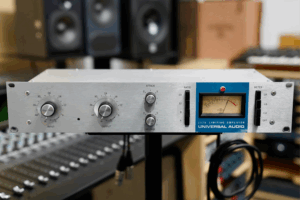
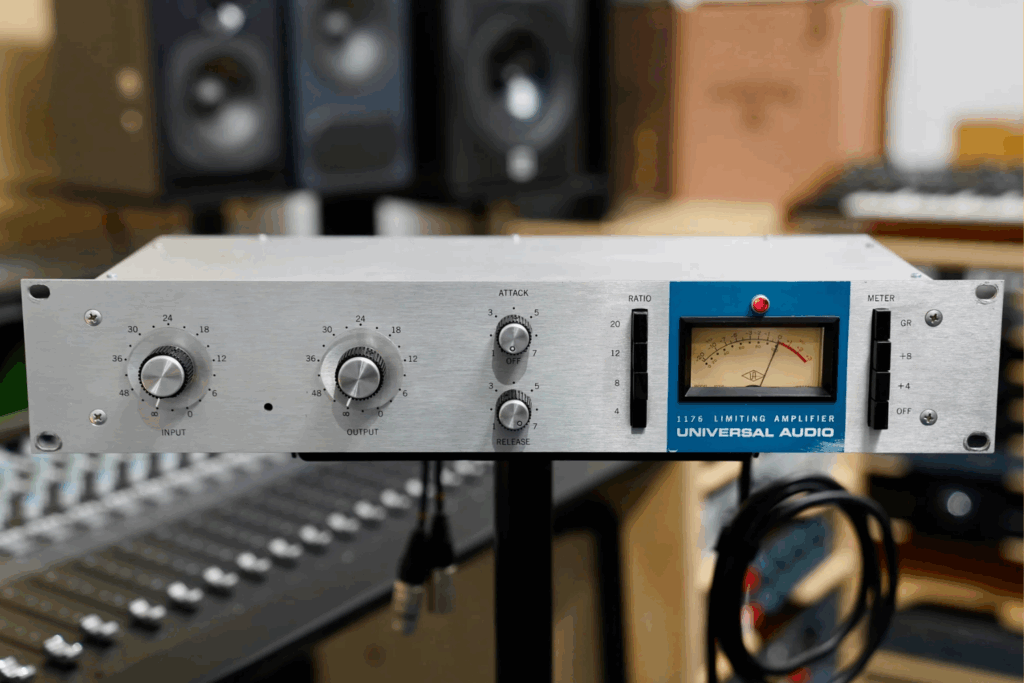
The 1176 is a legendary compressor/limiter designed by Bill Putnam Sr. in 1967. It was one of the first fully solid-state compressors, and it marked a major turning point in audio production history. With its ultra-fast attack, musical harmonic distortion, and powerful sound-shaping capabilities, the 1176 has become a go-to tool in professional studios worldwide.
1176 Revisions and Versions: What’s the Difference?
Over the years, multiple revisions of the 1176 have been released. While the core design remains, each revision has unique tonal characteristics due to differences in components, transformers, and circuit paths:
• Rev A (“Blue Stripe”)
The very first version. Bright, aggressive, and very colorful. Beloved on vocals and drums for its character.
• Rev B/C/D/E
More stable circuitry, lower noise. Slightly cleaner than Rev A, but still with the 1176’s signature punch. Rev E is often considered the “classic” version.
• Rev F/G
Output stage changed from Class A to push-pull. Cleaner, more modern sound. Great when you want control without too much color.
• 1176LN (Low Noise)
Modern version with reduced background noise. The basis for many modern hardware and plugin emulations.
How Does the 1176 Work?
The 1176 is a FET (Field Effect Transistor) compressor, which gives it a tube-like warmth in a solid-state design. The FET circuit delivers musical saturation and fast response, ideal for controlling peaks while adding character.
Key Features:
Ratio: From 4:1 up to ∞:1
Attack: 20 microseconds to 800 microseconds — ultra-fast
Release: 50 milliseconds to 1.1 seconds
All-Buttons Mode (“British Mode”): When all ratio buttons are engaged, the 1176 becomes a wild beast — perfect for heavy pumping, distortion, and creative compression
How and When to Use the 1176 in Your Mix
The 1176 is incredibly versatile, but some applications are where it truly shines:
🔹 Vocals
Great for adding presence, energy, and forward punch
Use medium-fast attack and fast release for an “in-your-face” vocal
🔹 Drums (Especially Snare and Room Mics)
All-Buttons Mode on room mics is legendary for bringing out ambience and smack
On snare, it adds crack and weight with aggressive character
🔹 Bass
Excellent for leveling dynamics and adding punch
4:1 or 8:1 ratios work best for thick, stable low end
🔹 Electric Guitars
Adds harmonic grit and makes parts sit tight in the mix
Also useful to tame harsh peaks without dulling the tone
Best 1176 Plugin Emulations
There are many software versions of the 1176 available today. Some of the most accurate and popular include:
UAD 1176 Collection (Universal Audio): The official emulation, with meticulous modeling of various revisions
Waves CLA-76: Offers two modes (Bluey and Blacky), great sound for the price
Slate FG-116: Adds modern controls while staying true to the vintage vibe
IK Multimedia Black 76
Arturia Comp FET-76
Is the 1176 Still Worth It Today?
Absolutely. Whether you’re mixing in the box or using analog gear, having access to an 1176 (or its emulation) is non-negotiable. It’s fast, musical, aggressive when needed, and always adds something valuable — even when pushed to extremes.
If you’re not using one, you’re leaving tone, punch, and impact on the table.