When it comes to professional mixing and mastering, one of the most underestimated aspects is the listening environment. You can have great monitors, excellent headphones, and strong technical skills, but if the room is not controlled, your decisions will be compromised.
Acoustic treatment doesn’t make the room “sound better” — it makes what you’re hearing more accurate.
How sound works and propagates in a room
Sound travels through space as waves. When these waves hit hard surfaces such as walls, ceilings, and floors, they reflect. Problems arise when the direct sound from the monitors combines with room reflections and reaches your ears at slightly different times.
This leads to:
frequency buildup
phase issues
altered balance perception
What happens with too many reflections
In an untreated room, early reflections and standing waves create peaks and nulls across the frequency spectrum. Some frequencies seem to disappear, while others are exaggerated.
The consequences are clear:
inaccurate EQ decisions
uncontrolled low end
mixes that don’t translate outside the room
This isn’t a listening skill problem — it’s an acoustic one.
How acoustic treatment works
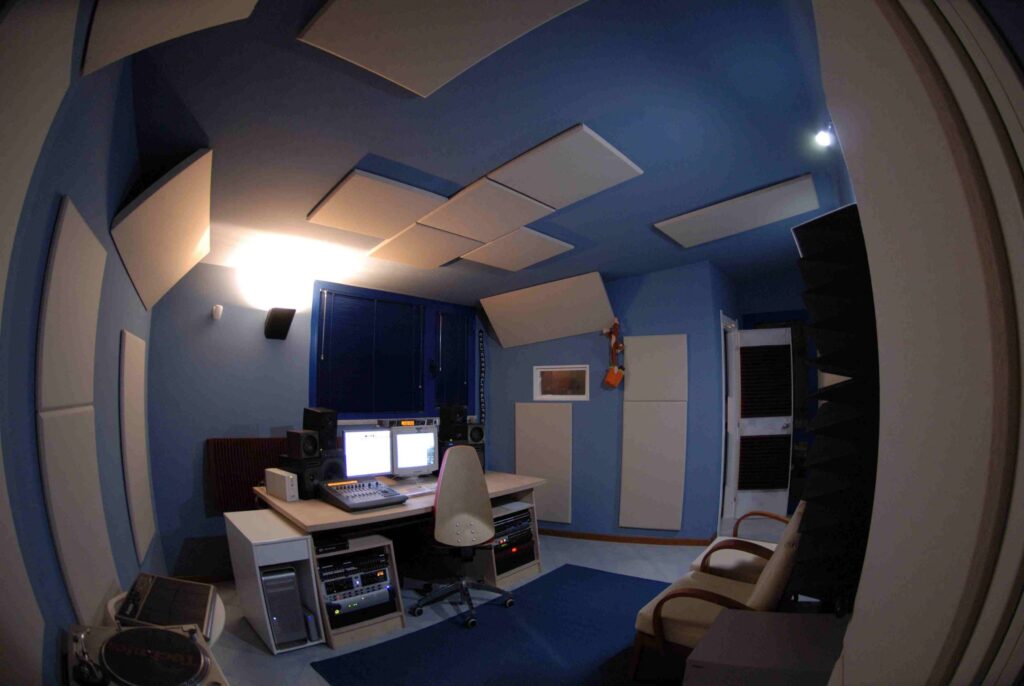
Acoustic treatment is about controlling sound behavior, not removing it. Using absorbers, bass traps, and diffusers, reflections are managed and resonances are reduced.
An effective treatment addresses:
low frequencies (the hardest to control)
primary reflection points
overall room response
Basic treatment vs professional treatment
Basic acoustic treatment improves listening but rarely solves all issues.
Professional acoustic treatment is designed specifically for the room, taking dimensions, materials, and real acoustic problems into account.
The difference lies in full-spectrum control and listening consistency.
Final room analysis and the goal of a flat response
The real goal of acoustic treatment is achieving a listening environment as flat and neutral as possible. This requires a final room analysis, measuring frequency response and decay times.
Even in well-treated rooms, it’s still good practice to use:
headphone calibration software
monitor correction systems
Not as shortcuts, but as support tools.
Learn your room and work with it
The key isn’t chasing the perfect room, but learning your room. Using multiple listening sources — monitors, headphones, car systems, phones, small speakers — provides confirmation, not correction.
When you learn to work with your environment, your decisions become more solid and your mixes finally translate.
Looking for professional mixing and mastering?
If you want to be guided through professional mixing and mastering, you can contact me via WhatsApp, Instagram, email, or by sending a request directly through the website.
The final sound is not a detail. It’s what makes the difference.