Over the years, mixing has become increasingly “visual.”
Huge waveforms, endless plugins, automation drawn with a mouse, and eyes constantly locked on the screen.
But there’s a problem:
the more you look, the less you actually listen.
That’s exactly where the value of a physical controller comes in.
Why mixing with physical faders feels different
Using real faders completely changes your relationship with mixing.
With a mouse:
- you work on one channel at a time
- movements feel unnatural
- decisions become more visual than musical
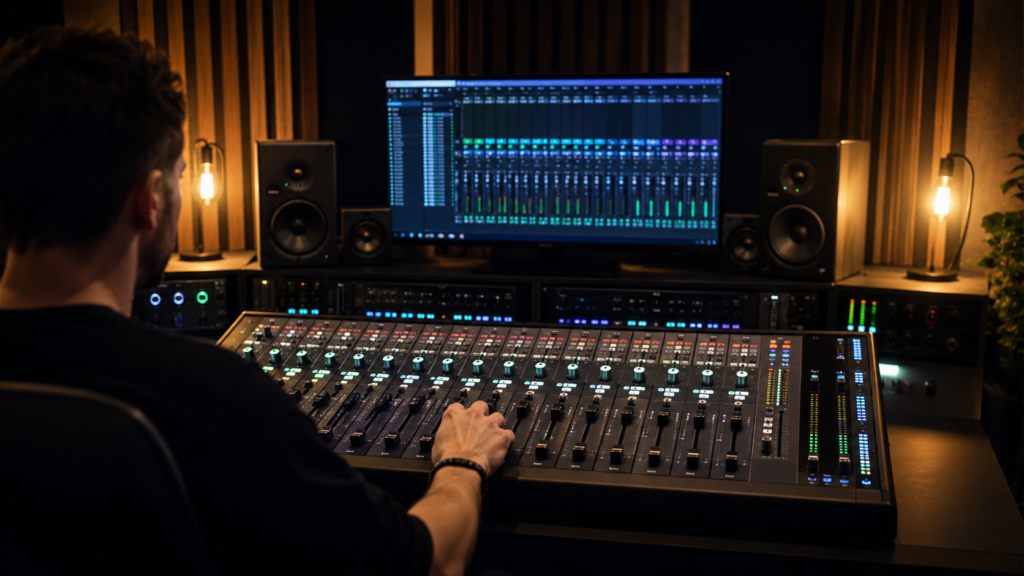
With a physical control surface instead:
- you can move multiple elements simultaneously
- you literally feel the mix under your hands
- the workflow becomes far more instinctive and musical
It stops feeling technical and starts feeling expressive.
Mixing becomes performance again
There’s a huge difference between:
- clicking a volume level
- actually “playing” a mix
When using physical faders, mixing regains a performative aspect. Automation becomes real movement — dynamic, fluid, human.
You’re no longer just editing parameters:
you’re interacting with the song itself.
My choice: SSL UF8
Personally, I chose to work with SSL UF8.
One of the biggest reasons is simple:
I wanted to close my eyes and truly mix with my ears.
Once you stop staring at the screen all the time:
- balances become clearer
- dynamics feel more natural
- musical decisions come easier
And it completely changes the way you experience mixing.
Analog feeling, digital workflow
What makes controllers like SSL UF8 so interesting is their ability to combine:
- the practicality of mixing in the box
- the tactile feeling of analog mixing
You still get:
- full session recall
- precise automation
- seamless DAW integration
But at the same time, you maintain that physical connection that makes mixing far more engaging.
The problem with modern mixing
Today, many mixes are made almost entirely “with the eyes.”
People constantly watch:
- waveforms
- meters
- spectrums
- gain reduction displays
And pay less attention to the actual sound.
A physical controller helps break that pattern and puts the focus back where it belongs:
on listening.
Conclusion
Mixing with physical faders is not mandatory.
You can absolutely achieve great results with just a mouse and keyboard.
But if you want a workflow that feels more musical, natural, and immersive, a control surface can genuinely change the way you approach mixing.
Because the best mixes often happen when you stop looking… and finally start listening.
Looking for professional mixing and mastering?
If you want to be guided through professional mixing and mastering, you can contact me via WhatsApp, Instagram, email, or by sending a request directly through the website.
The final sound is not a detail. It’s what makes the difference.